Meeting Announcement: Dr. Uwe J. Hansen to Speak on Phase Considerations in Signal Processing

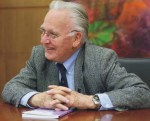
The Central Indiana Section of the Audio Engineering Society is pleased to announce that Dr. Uwe J. Hansen will speak on Phase Considerations in Signal Processing at our May 2011 meeting.

Dr. Hansen is Professor Emeritus of Physics at Indiana State University and a fellow of the Acoustical Society of America, among numerous other distinctions.

The meeting will be held in the conference room of ESCO Communications Indianapolis office. We also hope to offer a live web stream of the event, however, those able are encouraged to attend. To ensure an accurate count for the meeting, please RSVP below.

Live Stream Info
Due to a software issue, a live stream will not be available for this meeting, However, a video recording will be available online in short order. Please check back in the coming days. We appreciate the patience shown as we deal with a these technical issues.
Topic Abstract
The essential elements in describing a monochromatic wave are: amplitude, frequency, wavelength, speed of propagation, polarization and phase. Any interrelation between these characteristics is mostly determined by the interaction of the wave with the medium in which it travels. Thus dispersion relates to the frequency dependence of the propagation speed.

Amplitude, for example, is related to loudness in sound and brightness in light. Frequency or wavelength on the other hand relates to color in light and pitch in sound. Polarization considerations are limited to transverse waves such as electromagnetic waves or bending waves in structural vibrations. Phase identifies the location of a point along the propagating waves. Absolute phase measurements are not only difficult but generally not of interest.

Phase comparison, on the other hand is a powerful tool. The most obvious application is in active noise control, such as noise canceling head sets. Three applications of phase related signal processing techniques will be discussed: 1. Phase sensitive detection which is used to enhance signal to noise ratios in weak signals. 2. Optical holography, which relies entirely on phase comparison of coherent signals, and 3. Modal analysis, used to study normal mode vibration in structural systems.

About Dr. Hansen
With a Ph.D. in Low Temperature Solid State Physics from Brigham Young University, Dr. Uwe J. Hansen  joined the physics faculty at Indiana State University in 1968, after a post-doctoral fellowship at the US Naval Research Laboratory. Most of his work since then has been in the field of Musical Acoustics with emphasis on structural vibrations in musical instruments such as hand-bells, guitars, violins, piano sound boards, and Caribbean steel pans.

The tools he has used include holographic interferometry, modal analysis, and finite element analysis. He has lectured world-wide, has served as president of the Indiana Academy of Science, chairman of the Physics department at ISU and is currently serving as Executive Director of CSUI, and editor of the Proceedings of the IAS. As a fellow of the Acoustical Society of America he continues to do research and teach at ISU, though now retired.

To stay up to date on section activities, be sure to follow us on Facebook or Twitter, and feel free to contact any member of the executive board to let us know your thoughts about the section.
Meeting Report & Recording – March 2011 – John Murray And The 2010 NFPA 72 Fire Code

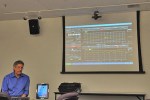
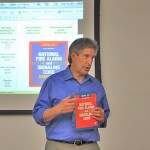
At this, the second of our meetings scheduled for the year which was held on March 17th, 2011 at 7pm, we were privileged to have John Murray speak on the new 2010 NFPA 72 fire code.

John has been an Audio Engineering Society member since 1980, is the principal and founder of Optimum System Solutions, and has seen a distinguished 30+ year career within the industry.

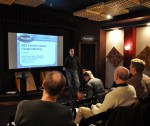
John Murray speaking to the Central Indiana AES. Click for more pictures.

A small but enthusiastic group was present at this meeting, which opened with brief introductions and announcements, moving directly to the presentation.

In his presentation, John discussed the new NFPA-72 regulations and how they relate to speech intelligibility and therefore to STI measurements. He explained how these measurements and the achievement of good speech intelligibility are necessary to meet the new regulations. John also demonstrated the process of measuring and evaluating STI in several spaces to show what is required and what measurements are required to pass the new code.

Another topic discussed were the various types of systems described within the code and what requirements regarding UL certified equipment and speech intelligibility would apply, and why this code change was an opportunity for contractors.

It was indicated that the new code imposes certain responsibilities upon those same contractors to design and install systems which would meet the new requirements. This means that the contractors will need to learn more about STI and testing in order to properly design and install projects to meet the new requirements.

The meeting was brought to us courtesy of Renkus-Heinz, Inc. and McFadden Sales., and our thanks go out to ESCO Communications for the continued use of their facilities.

With this meeting we’ve continued our initiative of recording events for archival purposes and to allow for participation from members unable to travel. The recording from this meeting is available below for playback. As well, those who are so inclined can also download the recording for playback in their audio program of choice. Our apologies in advance for the somewhat boomy nature of the recording.

We’d like to thank all who were in attendance. As always, those with questions or concerns are encouraged to contact us.

Meeting Announcement: John Murray to Speak on The New 2010 NFPA 72 Fire Code

The Central Indiana Section of the Audio Engineering Society is pleased to announce that John Murray will speak on the new 2010 NFPA 72 fire code at our March 2011 meeting.

The new code includes many changes which affect Mass Notification and Emergency Communication Systems, and have significant implications for system integrators. This meeting is brought to us courtesy of Renkus-Heinz, Inc. and McFadden Sales.

Meeting Information
Date: March 17, 2011 at 7:00pm
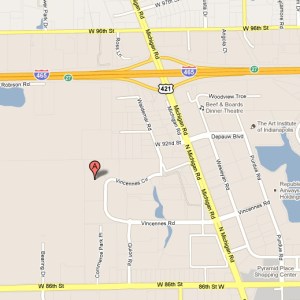
Location: ESCO Communications Conference Room
8940 Vincennes Circle, Indianapolis, IN 46268 (map).

About John Murray
John has been an Audio Engineering Society member since 1980 is the principal and founder of Optimum System Solutions, a sound-systems consulting firm, dedicated to optimize existing systems before resorting to an equipment upgrade.  His 34-year career in the sound industry spans time as a system contractor; designing and installing systems, working for manufacturers; creating products and training dealers to use them, and founding an independent sales representative firm, ProSonic Solutions; representing dozens of manufacturers to the dealer base.  He is a long-time instructor for the NSCA, INFOCOMM and Syn-Aud-Con, has presented two published AES papers, and is the technical editor of Live Sound International magazine.

To stay up to date on section activities, be sure to follow us on Facebook or Twitter, and feel free to contact any member of the executive board to let us know your thoughts about the section.

Meeting Report & Recording – January 2011 – Acoustic Treatment: Why & How

At this, the first of our meetings scheduled for the year which was held on January 27th, 2011 at 7pm, we regrettably had to deviate from our previously scheduled speaker.

Just hours before our meeting Eric Smith, Founder & President of Auralex Acoustics Inc., had to beg off the meeting due to rather severe illness.

Thankfully, Eric was kind enough to ensure that the Section was able to meet for the first time of the year and asked Andy Teipen and Emily Frame of to fill in. They spoke on “Acoustic Treatment: Why & How.” Eric will present his original topic “Bass Traps – What They Are, How They Are Made, And How To Use Them” in the year to come.

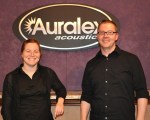
Emily Frame & Andy Teipen. Click for more pictures.

We opened the meeting by discussing the Section’s history and our proposed schedule for the remainder of the year. As well, we discussed opportunities of involvement in the section and throughout the region.

In the presentation of “Acoustic Treatment: Why & How,” Andy and Emily discussed the broad acoustical needs of most users and what acoustical treatments (Auralex and otherwise) can be used to solve them.

As promised, we’ve begun recording our meetings for archival purposes and to allow for participation from members unable to travel. The recording from this meeting is available below for playback. As well, those who are so inclined can also download the recording for playback in their audio program of choice.

We’d like to thank all who were in attendance for our first meeting and hope to serve our section well in the coming year. As always, those with questions or concerns are encouraged to contact us.

Webster Student Section Fifth Annual Central Region Student Summit Update

Riding on the success of the first, ever, anywhere Student Summit four years ago and three more successful follow-up events, the Webster University Student Section of the Audio Engineering Society will present the Fifth Annual Central Region AES Student Summit, March 18th – 20th, 2011, at Webster University in St. Louis, MO.

Last year’s Summit was a resounding success, with hundreds of students, educators and audio professionals from eleven states converging on Webster University.

Numerous guest speakers will be in attendance for the summit along with manufacturers as exhibitors and sponsors. Presentation ideas workshops and tutorials are welcome, and can be submitted to Andrea Pepper (see Call for Papers below). In past years these topics have included Internships and Entry Level Positions, the Analog Audio, Aesthetics, and Women in Audio, to name a few, and Webster plans to host a Mixing Competition, just as in past years only better, based on attendee suggestions!

The summit is, as in past years, being modeled upon AES conventions, except on a smaller scale. Unlike those wonderful, sometimes overwhelming conventions in New York or San Francisco, the Webster Students Section has arranged for inexpensive accommodations, and registration is practically free.

Whether or not you can make it to New York or London, this an extraordinary opportunity for students from the Central Region to mingle with their peers from other educational institutions as well as professionals. It will give you the same opportunity to put your hands on gear, just like on the exhibition floor at the Javits or the Moscone Center.

For students interested in the mixing competition the starting tracks are now available online and ready for download. Students, go ahead and download them and start mixing! Complete rules and entry information are available here.

The executive board of the Central Indiana Section hopes you will attend and will spread the word to everyone you know in the audio community: students, educators, pros, AES members and non-members alike.

Call For Papers / Presentations:
If you are interested in presenting a tutorial or workshop or moderating a panel, please email Andrea Pepper with the following:

  • Title
  • One paragraph description
  • Brief bio
  • .jpg of yourself
  • AV needs for the presentation or panel
  • Let them know if you would like other experts to join you for the presentation or panel.

More Information