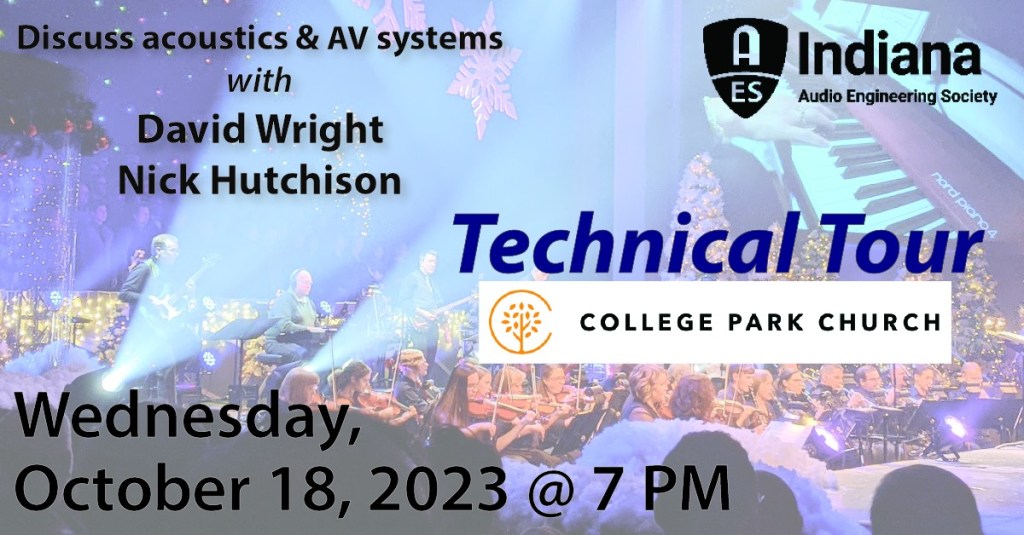
Join us for a review and discussion of an existing fan shaped 2,000 seat worship center with a survey of the acoustical design and sound system of the space. David Wright, Principal and Senior Acoustics Engineer at IMEG Consulting Corporation will discuss electro-acoustical factors in a successful venue where acoustical design and sound reinforcement systems work particularly well, and together. Acoustical benchmarks will be reviewed and College Park’s own A-1, Nick Hutchison will also review the AV systems and discuss what works for the room and the system.
Bi-Annual Election of Officers and Committeepersons
The bi-annual election for the Indiana Section is fast approaching! We urge AES members – full members and associate members in good standing (dues paid) to consider serving on the Executive Committee. The Executive Committee is comprised of Officers and Committeepersons.
Encouraging AES membership and actively participating in Section events is the primary way to grow our Section and the presence of audio professionals around the State. New leaders, bringing various backgrounds, are important to the continuation of an active and meaningful Section. The following positions will be on the ballot:
Section chair – leads committee meetings and guides organization of section events
Section vice-chair – assists in leading committee meetings and provides support for the chair
Section treasurer – manages section budget and maintains section accounts
Section secretary – recordings meeting minutes and files meeting reports
Executive committee member – help organize and arrange section events, advise section officers, and represent the section membership
Officer positions have a 2-year commitment; committee member positions may be a 1-year or 2-year commitment. Executive Committee meetings are typically held quarterly.
The election will be held online. Instructions and ballots with candidate bios will be sent via email in September.
To nominate yourself or another member of the Indiana Section, please email the name, AES member number, email address, and short bio & headshot (if available) to the current section secretary, Brett Leonard (leonardba@uindy.edu) by August 31st.
Note: If you are nominating another member, please be sure that you have contacted them and that they have agreed to be on the ballot and serve, if elected.
If you have questions about serving, terms, eligibility, etc. or to submit nomination, please contact section secretary Brett Leonard at leonardba@uindy.edu
Other business or activities at the meeting: Jay encouraged any non-members to join, and announced that section elections would be coming up in September.
Meeting Location: (virtual)
Summary
Frank began by providing some background on Dante. Dante as a platform includes both hardware components and software tools for control and interfacing, all integrated with a single management layer. This has recently expanded to include video integration in Dante AV, all managed from familiar Dante software. Dante AV includes options for lossless, low-latency video and multichannel audio, intermediate latency and video quality, and high-latency and lossy video.
Frank then moved to the evolution of Audio over IP (AoIP) systems. Early systems employed local, isolated network within a single room or facility, with all equipment interfacing through a single network switch. Similarly, a dedicated virtual LAN could be dedicated to AoIP use. As the network world expanded, IT departments became increasingly involved in these network, bringing a focus on network bandwidth requirements, larger coverage areas, Layer 3 routing, and security considerations.
To appreciate the complexities of modern systems, Frank took a dive into network architecture. The traditional Layer 3 network includes a core, distribution, and access layer, where newer network architecture often relies on a “spine and leaf” structure. Similarly, network security requirements have also expanded from a “defense in depth” paradigm to modern “zero trust” systems where every device’s interconnection must be configured. This, combined with increased network segmentation for differing uses, means that today’s AoIP network is a significant departure from the typical audio-visual professional’s focus on physical interconnection!
Dante Domain Manager (DDM) serves as a hub to simplify and integrate the varying hardware and software components in a modern network. Frank explained that DDM allows for device management and network segregation, as well as tiered access for users, monitoring and logging, and multi-subnet support, all within a single interface. This is particularly useful when using DDM to serve as a management layer for advanced routing between networks. In essence, DDM is a network engineer’s solution to AoIP. DDM can create customized dashboards, network monitoring, or GUIs, allowing for a streamlined user experience while maintaining security and network integrity.
Frank then dove into the future of AoIP and Dante. Dante Connect can transmit uncompressed audio through a cloud-based system to provide in-sync, lossless audio to remote users. Using Dante Gateway ,low-latency local networks can integrate with high-latency cloud distribution to bridge these networks. Further developments leverage WebRTC, to allow remote contribution of lossy audio, as well. Frank wrapped up taking some questions from the attendees.
Speaker Name: Matt Vice, IMS Productions; Steven Dixon, IMS Productions
Meeting Location: Indianapolis Motor Speedway; Indianapolis, IN, USA
Summary
Audio and streaming engineer Matt Vice and broadcast production engineer Steven Dixon led the Indiana section on small group tours of IMS Productions’ trucks as configured for the upcoming Indianapolis 500. The event, which draws almost a quarter of a million attendees and an average of 5 million viewers brings together a massive broadcast crew and infrastructure across the 560 acres of the Indianapolis Motor Speedway.
The broadcast compound outside of turn 4 of the track houses a number of broadcast trucks, all tied together with a Dante audio infrastructure and over 26 miles of fiber, facilitated by recent upgrades to the Speedway. The fiber infrastructure includes 288 total strands, half of which tie into “The Pagoda”, which houses race control and the main broadcast booths on the track. Truck B serves as the primary ingest point for fiber, with numerous patch points to distribute signals between trucks and the venue. Truck B also houses a 5.1 audio station where ambient sound and audio captured on the track is submixed. Engineer Rob Sweeny live-mixes these sources based on camera shots called by the director.
Truck C serves as the primary radio and replay location for the production. All racing team radio communications are received in this truck, and a dedicated mixer creates a submix of these tracks for use in broadcast. The other portion of the truck house multiple capture and playback recorders, where any items for potential playback are archived to a host of NAS devices.
A third truck, the BSI Truck, deals almost exclusively with in-car and action cameras. Each racecar has three mounted PTZ cameras. This truck handles control for those cameras, as well as a helicopter camera, two drone cameras, and a live map of the course. The other primary task of the BSI Truck’s crew is wireless coordination and RF comms for on-air talent in this crowded RF environment.
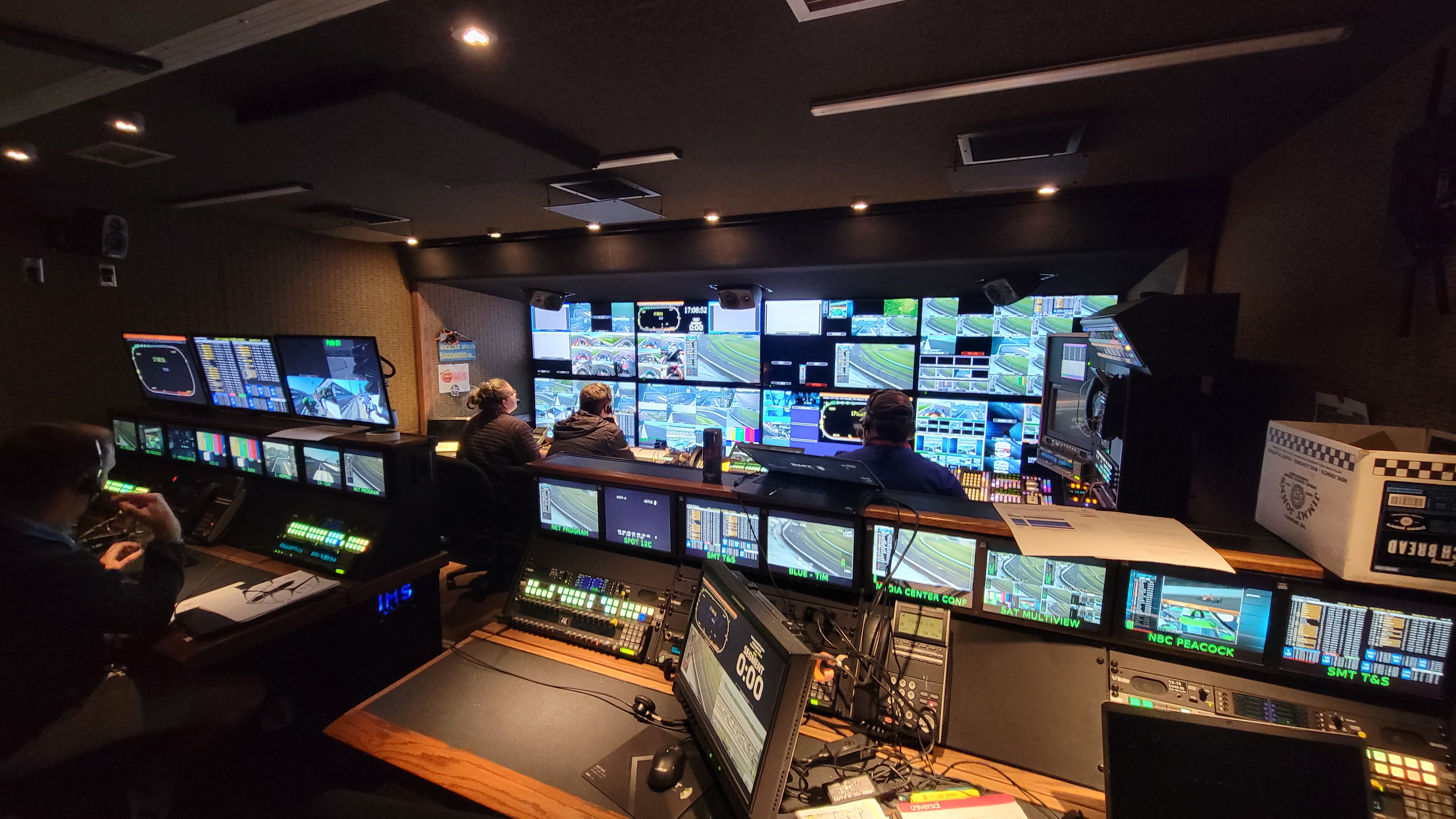
All audio and video converges in IMS’s HD5 Truck, which houses graphics, camera shading, final audio mix from the above submixes and talent mics. Director, producer, and video switching includes action cams and a variety of fixed and wireless shoulder-mount cameras in the pit. An additional reply team can provide immediate access to footage for the director and producer, who also work out of this truck. HD5 also provides monitoring of return feeds from numerous networks and serves as the broadcast crew comms hub for production.

 Indiana Section - Audio Engineering Society