Speaker Name: David Wright, IMEG; Nick Hutchison, College Park Church
Meeting Location: Indianapolis, IN
Summary
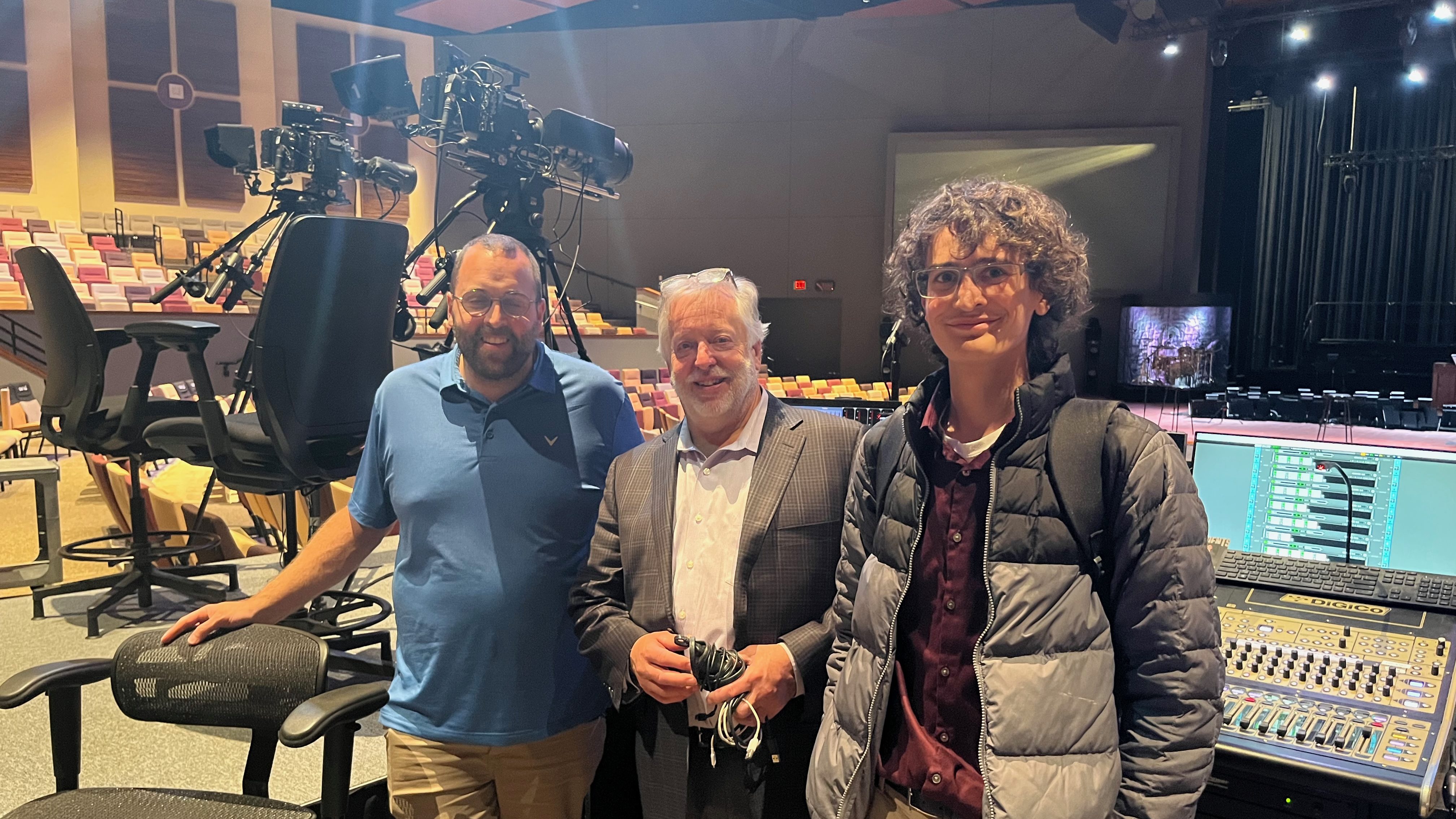
David began by referencing the common approach of adding absorption panels and audio equipment to achieve acceptable sound in a space. Rather, his (IMEG’s) approach is to measure and study the architecture of the space and then focus on the canopy and diffusion, with absorption being applied sparingly. Considerations for equipment (mixers, amps, speakers) should come last. David also noted that a stereo speaker array is OK if music needs to be reproduced but rarely works successfully for spoken voice; a mono array is best for voice. Nick demonstrated the system with several recorded clips of music performance as well as voice. He noted that a separate mix in the TV control room is used for streaming.
Other business or activities at the meeting: Jay encouraged any non-members to join, and announced that section elections would be coming up in September.
Meeting Location: (virtual)
Summary
Frank began by providing some background on Dante. Dante as a platform includes both hardware components and software tools for control and interfacing, all integrated with a single management layer. This has recently expanded to include video integration in Dante AV, all managed from familiar Dante software. Dante AV includes options for lossless, low-latency video and multichannel audio, intermediate latency and video quality, and high-latency and lossy video.
Frank then moved to the evolution of Audio over IP (AoIP) systems. Early systems employed local, isolated network within a single room or facility, with all equipment interfacing through a single network switch. Similarly, a dedicated virtual LAN could be dedicated to AoIP use. As the network world expanded, IT departments became increasingly involved in these network, bringing a focus on network bandwidth requirements, larger coverage areas, Layer 3 routing, and security considerations.
To appreciate the complexities of modern systems, Frank took a dive into network architecture. The traditional Layer 3 network includes a core, distribution, and access layer, where newer network architecture often relies on a “spine and leaf” structure. Similarly, network security requirements have also expanded from a “defense in depth” paradigm to modern “zero trust” systems where every device’s interconnection must be configured. This, combined with increased network segmentation for differing uses, means that today’s AoIP network is a significant departure from the typical audio-visual professional’s focus on physical interconnection!
Dante Domain Manager (DDM) serves as a hub to simplify and integrate the varying hardware and software components in a modern network. Frank explained that DDM allows for device management and network segregation, as well as tiered access for users, monitoring and logging, and multi-subnet support, all within a single interface. This is particularly useful when using DDM to serve as a management layer for advanced routing between networks. In essence, DDM is a network engineer’s solution to AoIP. DDM can create customized dashboards, network monitoring, or GUIs, allowing for a streamlined user experience while maintaining security and network integrity.
Frank then dove into the future of AoIP and Dante. Dante Connect can transmit uncompressed audio through a cloud-based system to provide in-sync, lossless audio to remote users. Using Dante Gateway ,low-latency local networks can integrate with high-latency cloud distribution to bridge these networks. Further developments leverage WebRTC, to allow remote contribution of lossy audio, as well. Frank wrapped up taking some questions from the attendees.
Speaker Name: Matt Vice, IMS Productions; Steven Dixon, IMS Productions
Meeting Location: Indianapolis Motor Speedway; Indianapolis, IN, USA
Summary
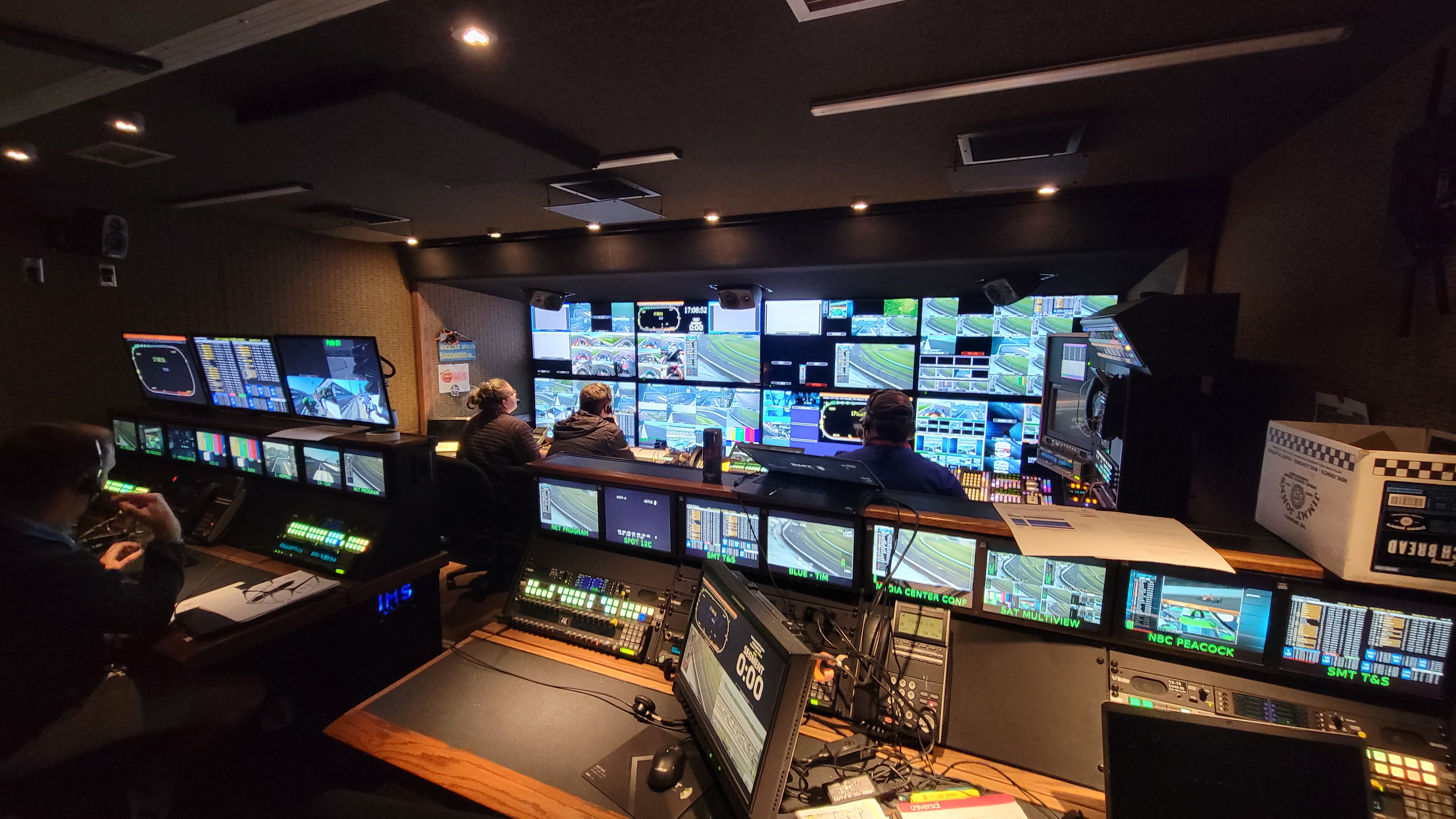
Audio and streaming engineer Matt Vice and broadcast production engineer Steven Dixon led the Indiana section on small group tours of IMS Productions’ trucks as configured for the upcoming Indianapolis 500. The event, which draws almost a quarter of a million attendees and an average of 5 million viewers brings together a massive broadcast crew and infrastructure across the 560 acres of the Indianapolis Motor Speedway.
The broadcast compound outside of turn 4 of the track houses a number of broadcast trucks, all tied together with a Dante audio infrastructure and over 26 miles of fiber, facilitated by recent upgrades to the Speedway. The fiber infrastructure includes 288 total strands, half of which tie into “The Pagoda”, which houses race control and the main broadcast booths on the track. Truck B serves as the primary ingest point for fiber, with numerous patch points to distribute signals between trucks and the venue. Truck B also houses a 5.1 audio station where ambient sound and audio captured on the track is submixed. Engineer Rob Sweeny live-mixes these sources based on camera shots called by the director.
Truck C serves as the primary radio and replay location for the production. All racing team radio communications are received in this truck, and a dedicated mixer creates a submix of these tracks for use in broadcast. The other portion of the truck house multiple capture and playback recorders, where any items for potential playback are archived to a host of NAS devices.
A third truck, the BSI Truck, deals almost exclusively with in-car and action cameras. Each racecar has three mounted PTZ cameras. This truck handles control for those cameras, as well as a helicopter camera, two drone cameras, and a live map of the course. The other primary task of the BSI Truck’s crew is wireless coordination and RF comms for on-air talent in this crowded RF environment.
All audio and video converges in IMS’s HD5 Truck, which houses graphics, camera shading, final audio mix from the above submixes and talent mics. Director, producer, and video switching includes action cams and a variety of fixed and wireless shoulder-mount cameras in the pit. An additional reply team can provide immediate access to footage for the director and producer, who also work out of this truck. HD5 also provides monitoring of return feeds from numerous networks and serves as the broadcast crew comms hub for production.
Meeting Topic: Careers in Audio: What’s your connection? (Winter 2023)
Moderator Name: Jay Dill
Speaker Name: Eric French, WOSU; Eric Brown, American Sound & Electronics; Lesley Ann Fogle, AES Columbus Section Chair
Meeting Location: virtual (Zoom)
The second joint meeting of the Indiana and Columbus, OH sections began with a round of introductions from our panelists. Eric French is a senior broadcast technician and engineer at WOSU, which encompasses multiple radio stations, as well as TV broadcasting. Eric Brown is the general manager of American Sound’s Indianapolis office, managing a team implementing a variety of audio, video, and other technical solutions for a wide range of projects. Lesley Ann Fogle rounded out the panel to lend her expertise as the internship coordinator at Capital University’s music technology program.
The panel began by discussing the internship programs at both entities. For American Sound’s internship program, the focus is on getting interns into the field ASAP. This provides context for the complexity of projects, as well what goes into a successful project; understanding the overlap between skillsets and interdependence of different departments is critical to a smooth project.
WOSU’s intern program tends to draw heavily from higher education institutions, word of mouth, and even the armed forces. Interns tend to arrive with either musical or computer engineering backgrounds, and find homes in departments closely related to their background. Most interns are started with hands-on tasks that illustrate attention to detail and the ability to meet deadlines; this provides an important gauge of an intern’s capabilities to move on to broadcast-critical tasks.
The panelists agreed that willingness to learn and apply existing skills in new ways are critical characteristics of a successful intern. In both programs, interns may find themselves outside of their areas of knowledge, so a teachable disposition and a desire to learn are important. On the job training is available in both cases. Diligence and reliability were also highlighted as key skills. Eric French also noted that trying new things can often lead interns to reorient their careers to different areas of the industry with which they had no prior experience. The panel also highlighted an understanding that the work isn’t always glamourous, but everyone does what it takes to keep projects moving and the station on the air.
Discussion then moved to obtaining and internship or job. The key word from all was “persistence”; keep calling, keep networking, and make connections through industry organizations like the AES. Also important is researching your potential employer to understand what they do and how your skills overlap with that entity.
Meeting Topic: Careers in Audio: What’s your connection?
Moderator Name: Jay Dill
Speaker Name: Ted Chandler, Markey’s Rental & Staging; Lesley Ann Fogle, AES Columbus Section Chair; Paul Kavicky, Columbus Association for the Performing Arts
Meeting Location: virtual (Zoom)
Summary
This joint virtual meeting of the Indiana and Columbus, OH sections began with introductions from the diverse group of panelist. Paul Kavicky serves as the head of audio-video production at Columbus Association for the Performing Arts (CAPA), where he serves as department head for audio at show sites where audio is produced internally. Ted Chandler worked his way through the hierarchy of Markey’s, ranging from driver to on-site audio technician, and most recently as Training and Development Manager. In addition to her work in location sound and audio post production, Lesley Ann Fogle also serves as adjunct faculty at Capital University’s music technology program where she coordinates student internship experiences.
The discussion began with Markey’s internship program, which focuses on immediate hands-on application of audio skills, but quickly expands to other trades such as video and lighting. CAPA’s internship program typically places participants at a smaller (500-seat) theatre where production is handled in-house. Both allow interns to learn the intangibles of work pacing and inter-department coordination. Certain audio skills are assumed, but an intern shines through a strong work ethic, contentiousness, people skills, and a focus on accomplishing the task at hand. For Markey’s having a secondary knowledge in staging, lighting, video, or others can also be a huge asset. All agreed that applying knowledge to new situations and troubleshooting were also important.
Preparation for an internship is critical, as well. Leslie starts students by conducting research about companies before reaching out about an internship. Persistence and proper self-presentation are key components, as well. A well-formed resume and cover letter showing effort are important, and presenting a professional image with appropriate dress and punctuality is critical. For Paul, applicants may be brought on for a single gig to showcase both hard and soft skills.
An intern’s duties vary, as well. For both CAPA and Markey’s, interns not only focus on their production specialty, but will also expand in their range of experience to other disciplines. Hands-on work begins on day one with the expectation that interns both work and observe, and may quickly find themselves serving a role within a production, given the right attitude and skillset.
The session concluded questions from the audience. Questions touched on topics such as unpaid internships, opportunities for military veterans and less client-facing roles within the industry, and ways to make yourself stand out on the job.
 Indiana Section - Audio Engineering Society