Meeting Report: Automatic Mic Mixing

Meeting Topic: Automatic Microphone Mixing: How and Why?

Moderator Name: Jay Dill and Nate Sparks

Speaker Name: Michael Pettersen and Gino Sigismondi, Shure

Other business or activities at the meeting: General welcome, introduction to the section and section’s website/social media, and information on joining the AES for non-members.

Meeting Location: Online (YouTube stream with Q&A)

Summary:

Moderator’s Jay Dill and Nate Sparks joined Shure’s Michael Pettersen and Gino Sigismondi for the Central Indiana Section’s inaugural webcast to discuss the history and current state of automatic microphone mixing. The presentation began with an in-depth overview of the history of automatic mixing dating back to the original concept brought forward by famed theatre sound designer Dan Dugan. Dugan’s initial concept allowed a theatre mixer to offload the task of muting and unmuting (or fader riding) multiple microphones as actors delivered lines and entered or left stage. This functionality helps optimize gain before feedback, prevented comb filtering, and reduced buildup of background noise and reverberation.

Shure entered the automixing market in the early 1970s with the Voicegate, a speech-centric gating system. By the mid-70s, advancements allowed for variable threshold operation, as well as implementing gain sharing, a system which maintains a sum total gain for all open channels as channels are added or subtracted, thereby creating a more stable system. Further advances heralded a dual-element microphone with a secondary, rear-facing capsule providing a differential to ensure only on-axis input signals triggered unmuting, and system linking to allow for more channels.

The next wave of development included adaptation to ambient noise and the ability to work with non-proprietary microphones. This system grew into the famed FP-410, which included MaxBus, a system to ensure that the loudest receiver capturing a single source would remain open, a system to ensure that the last microphone used would remain open, and the implementation of “off-attenuation”, which used approximately 15 dB of gain reduction rather than full muting of sources. These technologies have rolled into the systems we know as IntelliMix.

As the world of audio migrated way from analog processing, IntelliMix went digital. While the aims of automixing remain the same, the processing tasks of signal detection, channel priority, gain-sharing, etc. have been merged into DSP-based systems in both hardware and software. Current automixing offerings retain this functionality, but also allow for configuration of all aspects of the system via a browser-based GUI. Traditional functionality can also be coupled with additional audio enhancement processing and digital I/O for maximum flexibility.

The presentation was facilitated by Force Technology Solutions’ live streaming studio, allowing broadcast-style graphics and switching, off-site production, and remote presentation from across the Midwest. The lecture can be can be viewed on the Central Indiana Section’s YouTube channel or directly at https://youtu.be/diWqymbEuhw.

Written By: Brett Leonard
Automatic Mic Mixing: Why and How – Free Webinar

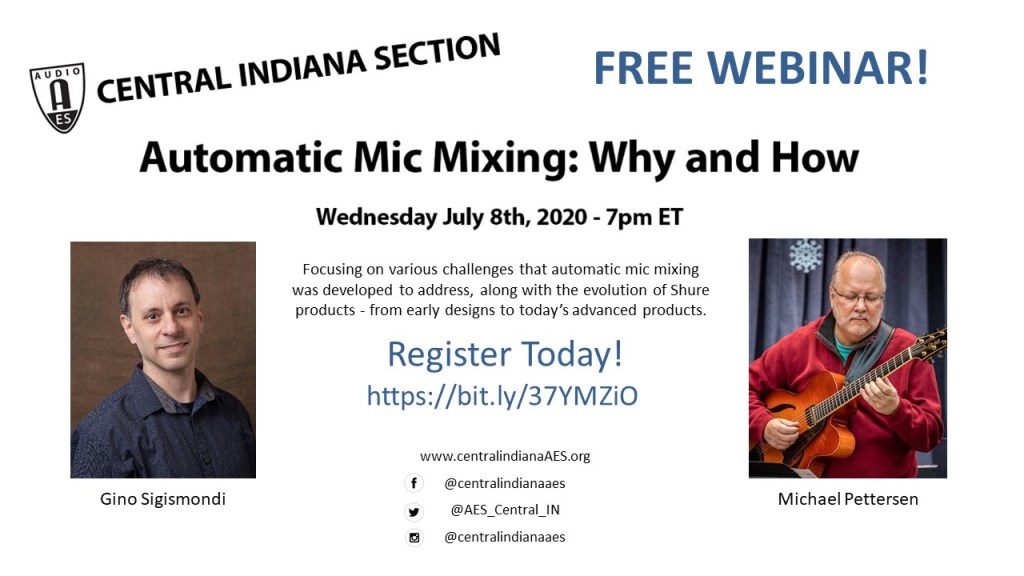
What: Automatic Mic Mixing:  Why and How

When: Wednesday, July 8, 2020, 7:00 P.M. (ET)

Where: https://bit.ly/37YMZiO

Join us when guest presenters Gino Sigismondi and Michael Pettersen will be reviewing the various challenges automatic mic mixing was developed to address, along with the evolution of Shure products – from early designs to today’s advanced products.

They will note various applications for installed systems, such as: education, board rooms,courtrooms, legislative halls, convention facilities, houses of worship and broadcast studios.

Gino Sigismondi is Associate Director of Technical Support & Training at Shure, Inc. Michael Petterson is Director of Corporate History at Shure, Inc.

You must register via this Eventbrite Link (free) in order to receive the link to join the webinar:

AES Virtual Vienna 2020

International Online Convention June 2-5 2020

Registration is now open at a reduced price!

Amidst the turmoil of the current global health situation, the Audio Engineering Society’s 148th International Convention is going online!  Join us for the Virtual Vienna Convention, with online sessions from presenters including Thomas Lund (Genelec), Eddy Brixen (DPA), Nadja Wallaszkovits (Austrian Academy of Sciences), Daniel Belcher (d&b audiotechnik), Bob McCarthy (Meyer Sound), Alex Case (UMass Lowell;Focal Press), and many more!  

Some live presentations will air in the morning through early afternoon in the Eastern timezone, while others are available on-demand.  Registration has been drastically discounted.  

Check out the events and register at AES Vienna 2020.


AES Vienna

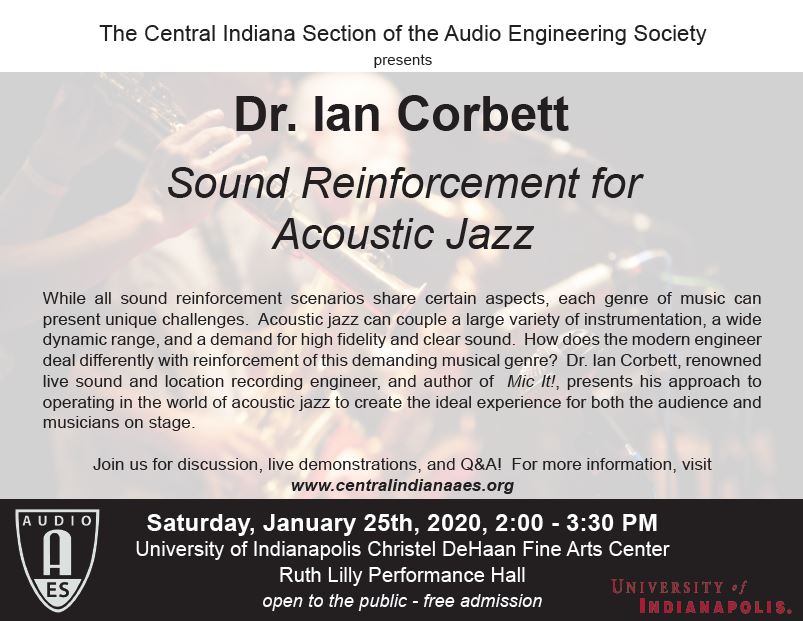
Sound Reinforcement for Acoustic Jazz with Dr. Ian Corbett

What: Sound Reinforcement for Acoustic Jazz with Dr. Ian Corbett
When: January 25, 2020 – 2:00pm – 3:30pm 
Where: University of Indianapolis, Christel DeHaan Fine Arts Center ( 1400 E Hanna Ave, Indianapolis, IN 46227 )
RSVP: Use our Eventbrite page or our Contact form

While all sound reinforcement scenarios share certain aspects, each genre of music can present unique challenges. Acoustic jazz can couple a large variety of instrumentation, a wide dynamic range, and a demand for high fidelity and clear sound. How does the modern engineer deal differently with reinforcement of this demanding musical genre? Dr. Ian Corbett, renowned live sound and location recording engineer, and author of Mic It!, presents his approach to operating in the world of acoustic jazz to create the ideal experience for both the audience and musicians on stage. Join us for discussion, live demonstrations, and Q&A!

This event is free and open to the public

Eventbrite - AES - January 2016 Meeting at Clowes Hall

Live Sound for a Major Musical Show and Holiday Dinner

Live Sound for a Major Musical Show and Holiday Dinner
(Please read carefully.)

When/Where: FRIDAY, DECEMBER 6, 2019, 4:15 PM @ Hilbert Circle Theater followed by Dinner at Shapiro’s ~ 5: 45 PM.

Join us for a hands-on talk with Alan Alford, audio engineer for the Indianapolis Symphony Orchestra, as he explains the details and challenges for the ISO’s 34 st annual IPL Yuletide Celebration musical production. Among the challenges of this production is handling over 35 wireless microphone systems. This season, Alan will be using a Yamaha PM7 console, the Shure Axient wireless radios and Clear-Com FreeSpeak wireless systems.

NOTE: There is a tight window for this session – the talk with Alan will begin promptly at 4:15 PM and end at 5:15 PM. We have been asked to assemble just inside the 32 E. Washington Street entrance (Symphony Center) by 4:15 PM; specifically, do NOT enter the theater by the main doors on the Circle.

Also, because of the tight schedule and very busy backstage area, it is important that you RSVP so we can have an accurate list of those attending – otherwise, you may not be able to be admitted.

There are two Yuletide productions that day, one at 2:00 PM and the other at 8:00 PM. Frankie Moreno is this year’s host. You may wish to attend one of these (your option) in order to have a greater appreciation for the magnitude and complexity of the task of handling live sound for this major production. (We are not able to hold a block of tickets; that is, you must purchase your own ticket(s), available online at www.indianapolissymphony.org.) HCT is located at 45 Monument Circle, Indianapolis. Parking is available in several nearby garages and at Circle Center (underground).

Immediately following we will proceed to the nearby Shapiro’s restaurant, 808 S. Meridian, for a holiday dinner.  Cost for AES members only will be $7.00, with the balance being subsidized by the Section.  Treasurer, Phil Hodson, will take your $7 share (cash only) before paying the total bill.  Non-AES members will need to pay the full amount.

Eventbrite - Central Indiana AES December Meeting
Eventbrite - Dinner at Shapiro's